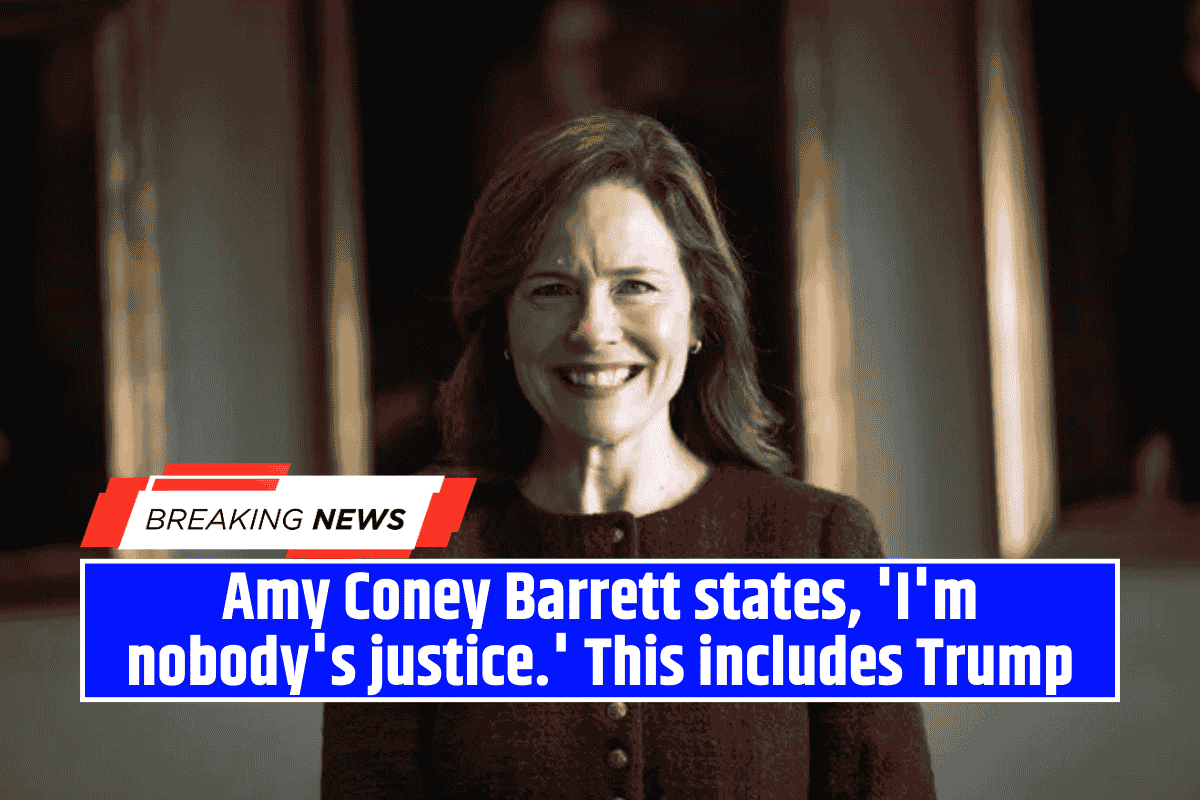
When Amy Coney Barrett was nominated to the Supreme Court by President Donald Trump in 2020, many assumed she would be a reliable ally for his administration. Her supporters anticipated consistent conservative rulings, while critics feared the same. Yet five years later, Barrett has defied both camps.
“I’m nobody’s justice,” Barrett declared in a wide-ranging interview with USA TODAY about her new book, Listening to the Law. Now regarded as an occasional swing vote on a solidly conservative court, Barrett has both surprised legal analysts and angered some of Trump’s most loyal supporters.
When asked what she would do if Trump called her, she laughed: “I might wonder if he had the wrong number.”
Listening to the Law, Not Politics
One of Barrett’s central goals in her book is to reassure Americans that justices base decisions on the law, not political preference. “The justices don’t make their decisions based on personal preference or politics,” she explained.
That message may be a hard sell. A 2024 USA TODAY/Ipsos poll found most Americans believe the Court rules on ideology, not law. Pew Research Center data also show public confidence in the Court hovering near a three-decade low. Still, Barrett insists her role is to “listen to the law.”
On Presidential Power and Precedent
Barrett has drawn criticism for opinions expanding presidential power, including a landmark ruling presuming presidents enjoy immunity for official acts. Some argue such decisions tilt the constitutional balance between the branches of government.
But Barrett rejects the idea that the Court caters to any president. When Justice Ketanji Brown Jackson suggested the Court acts as though “this administration always wins,” Barrett pushed back: “It’s about the presidency. The decisions we make today will still be precedent three or four presidents from now.”
She emphasized that the Court must “stay in its lane,” making rulings grounded in legal doctrine, not abstract theories about checks and balances.
Balancing the Court and Parenthood
At 53, Barrett is the youngest justice and the first with school-age children to serve on the Supreme Court. As the mother of seven—including a child with Down syndrome and two adopted from Haiti—her daily life looks different from her colleagues’.
Her family experiences, she admits, sometimes shape her perspective. During arguments about age verification on adult websites, Barrett challenged an attorney’s suggestion that parents could simply block content: “Content filtering for all those devices, I can say from personal experience, is difficult to keep up with.”
Her background as a parent of a child with special needs also informs her empathy in cases involving education law. “Most parents of children with special needs would tell you that it does something to your level of compassion and just how you perceive people,” she said.
A Sharp Exchange with Justice Jackson
Though Barrett usually describes her writing style as “one jalapeño” mild, she has occasionally turned up the heat. In response to Justice Jackson’s dissent criticizing a majority ruling on presidential power, Barrett accused her colleague of launching a “startling line of attack” untethered to any doctrine.
Explaining the unusually sharp tone, Barrett said: “Jackson made her arguments forcefully, and I thought they merited our response. I am typically a one jalapeño gal—but I am from Louisiana, and I enjoy Tabasco once in a while.”
Criticism from the Right
Despite Trump’s public praise after she authored one opinion favorable to him, some conservatives have soured on Barrett. Critics on the right have labeled her “squishy” or even a “disappointment.”
But Barrett dismisses the notion that justices should reflect the will of those who appointed them. “Ever since George Washington picked the first five members of the high court, all presidents have hoped their appointments would be ‘their’ justices,” she said. “And throughout history, presidents have been disappointed.”
She also rejects being called a “swing vote.” To her, the label implies indecision. “That’s not how I approach the law at all,” she said.
Strength Over Stereotypes
Barrett acknowledges that when she first joined the Court, some viewed her as a “shrinking violet.” She believes her performance has disproved that perception. “Hopefully, those have fallen by the wayside just in the way that I’ve conducted myself in the job,” she said.
The larger misconception, she insists, is the assumption that justices base decisions on personal beliefs. “I’ve disagreed with all of my colleagues at different times,” she said. “That’s because I’m not trying to march in lockstep with anyone. We’re just trying to get the law right. I’m a lawyer.”