Former President Donald Trump has often suggested he might pursue a third term, despite acknowledging constitutional barriers. This possibility has drawn attention from the nation’s highest court.
Recently, two Supreme Court justices — Amy Coney Barrett and Sonia Sotomayor — weighed in on whether the Constitution’s 22nd Amendment makes such a run impossible.
What the 22nd Amendment Says
The 22nd Amendment to the U.S. Constitution, ratified in 1951, establishes clear limits on presidential terms. It states that no individual “shall be elected to the office of the President more than twice.”
This language has long been interpreted to prohibit any president, including Trump, from seeking a third electoral victory.
Justice Barrett’s Position
At a September 8 event, Justice Amy Coney Barrett, a Trump appointee, offered a straightforward reading of the amendment. Asked whether the rule was “cut and dry,” she responded, “That’s what the amendment says.”
While refraining from offering a legal prediction, Barrett emphasized the plain wording of the constitutional provision.
Justice Sotomayor’s Perspective
Justice Sonia Sotomayor, appointed by President Barack Obama, addressed the issue during an appearance on The View on September 9. She noted that no court case has tested the amendment, leaving some uncertainty.
However, Sotomayor reaffirmed that the Constitution explicitly imposes a two-term limit, stressing its authority as the highest law of the land.
Speculation About Workarounds
Despite the amendment’s clarity, political commentators have speculated about potential loopholes. One floated idea suggests Trump could run as vice president alongside an ally, such as current Vice President JD Vance, and then assume the presidency if that ally resigned.
Neither Barrett nor Sotomayor commented on the constitutionality of such a maneuver.
Trump’s Own Mixed Signals
Trump himself has expressed conflicting views on the matter. In a March interview with NBC, he hinted that “methods” might exist to make a third term possible.
Yet by May, during an appearance on Meet the Press, he admitted he believed the Constitution barred it, saying, “To the best of my knowledge, you’re not allowed to do it.”
Public Messaging and Merchandise
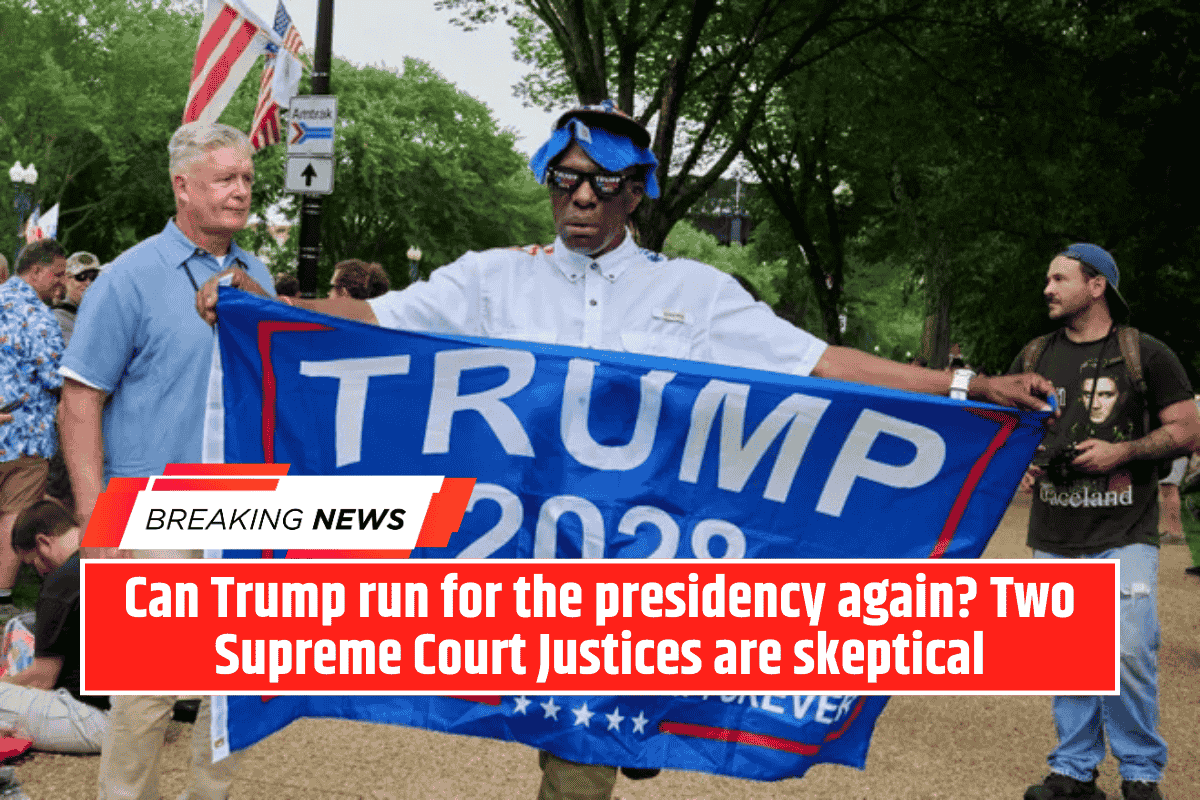
Even with legal doubts, Trump’s political brand has embraced the possibility of a third run. The Trump Organization is currently selling “TRUMP 2028” hats for $50 each, signaling a symbolic continuation of his political influence.
Trump’s son, Eric, has even worn the merchandise publicly, adding to speculation about his father’s intentions.
The Supreme Court’s Role
Ultimately, the question of Trump’s eligibility for a third term would fall to the Supreme Court if formally challenged. While both justices acknowledged the authority of the 22nd Amendment, neither suggested the Court had yet ruled on the matter. Until then, the issue remains a matter of constitutional interpretation and political debate.
Broader Implications
The discussion reflects more than Trump’s ambitions; it highlights the enduring importance of constitutional safeguards. The two-term limit, introduced after Franklin D. Roosevelt’s four terms, was intended to preserve democratic balance and prevent consolidation of power.
Whether tested by Trump or another candidate, the amendment represents a defining guardrail in U.S. governance.