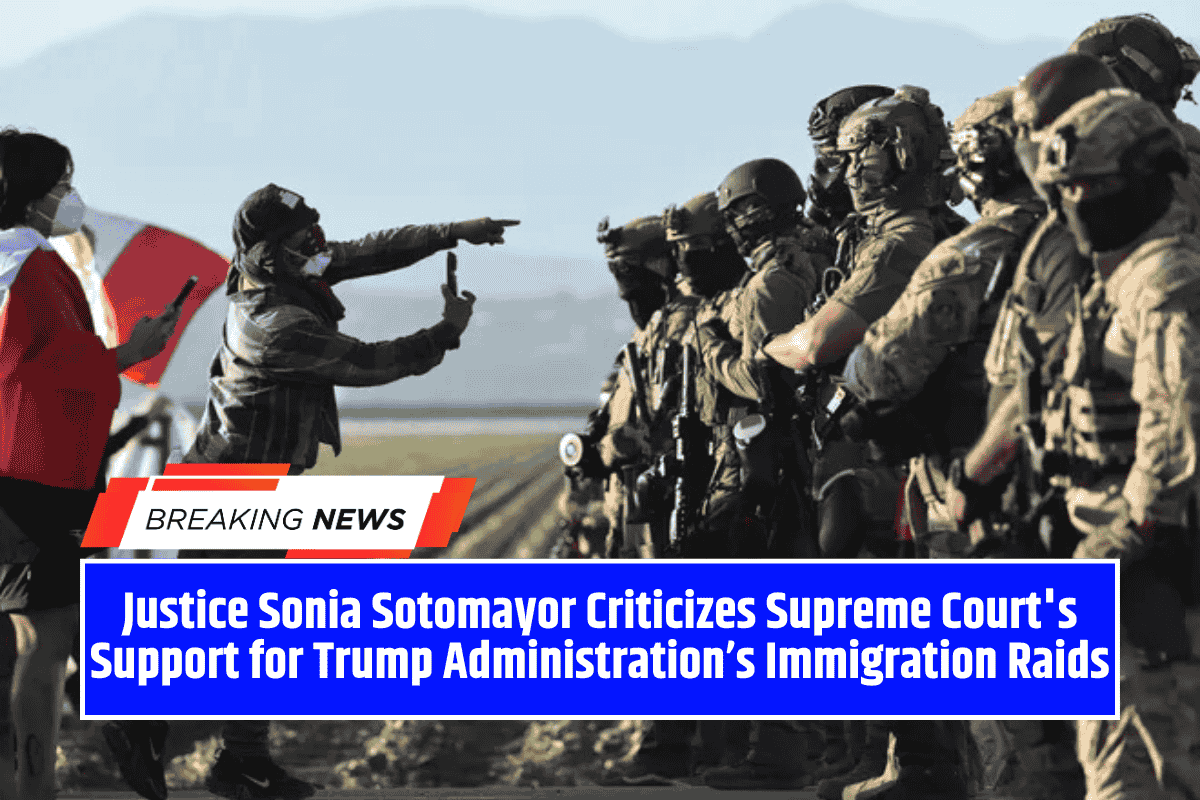
The Trump administration’s immigration enforcement policies, specifically in Los Angeles, have sparked significant controversy. On September 8, the Supreme Court lifted a restraining order issued by a federal judge in Los Angeles that had restricted U.S.
Immigration and Customs Enforcement (ICE) agents from conducting immigration stops without reasonable suspicion. This move, supported by the Court’s conservative majority, has escalated tensions surrounding immigration enforcement, especially in communities with large Latino populations.
In July, U.S. District Judge Maame Frimpong ruled that ICE agents could not solely rely on someone’s race, language, or occupation—such as working at a day laborer pickup site—as the basis for immigration stops.
This decision was an attempt to curb racial profiling, which critics argued was rampant in ICE operations. However, the Supreme Court’s reversal of this ruling represents a significant shift, granting the Trump administration broader powers in its immigration enforcement efforts.
Sotomayor’s Dissent: A Blistering Critique
Justice Sonia Sotomayor, who has long been a vocal critic of the administration’s immigration policies, condemned the Court’s decision in a scathing 21-page dissent.
Sotomayor described the Court’s ruling as a “grave misuse” of the emergency docket and criticized the majority for allowing the government to seize individuals based on their ethnicity, language, and occupation.
“We should not have to live in a country where the Government can seize anyone who looks Latino, speaks Spanish, and appears to work a low-wage job,” she stated, emphasizing the discriminatory nature of such practices.
Sotomayor’s dissent highlighted the constitutional violations she believes are inherent in these immigration raids, particularly the risks to the Fourth Amendment, which guarantees protection from unreasonable searches and seizures.
She argued that the ruling could result in the unjust targeting of Latinos—both citizens and non-citizens—simply because of their appearance or job type, without any real evidence of illegal activity.
Justice Kavanaugh’s Support for ICE’s Authority
Justice Brett Kavanaugh, who sided with the Trump administration, offered a different perspective. In his concurrence, Kavanaugh defended ICE’s authority to conduct immigration stops based on reasonable suspicion, including the consideration of factors like ethnicity.
While he acknowledged that ethnicity alone is not enough to justify a stop, Kavanaugh argued that it could still be a relevant factor when combined with other factors, such as a person’s location or activities.
Kavanaugh’s reasoning reflects a longstanding approach to immigration enforcement, where stops and questioning based on reasonable suspicion have been seen as a necessary tool for upholding immigration laws.
However, Sotomayor sharply disagreed, pointing out that ICE agents are not merely questioning individuals; they are forcibly detaining them, often with the use of firearms and physical violence.
Concerns About Racial Profiling and the Fourth Amendment
Sotomayor expressed grave concerns about the implications of the Court’s decision for the protection of civil rights.
She warned that, after this ruling, the Fourth Amendment’s safeguard against arbitrary interference by law enforcement could be compromised, particularly for individuals who “look a certain way, speak a certain way, and appear to work a certain type of legitimate job that pays very little.”
Her dissent underscores a fear that the decision opens the door for increased racial profiling, particularly against Latino communities, by enabling ICE to target individuals based on superficial characteristics rather than tangible evidence of wrongdoing.
Sotomayor’s critique highlights the potential for this decision to erode constitutional protections for vulnerable populations.
Impact on Latino Communities and Public Protests
The decision comes amidst a backdrop of growing protests and resistance to the Trump administration’s aggressive immigration enforcement policies.
Since June, the administration has expanded its scope, not just targeting individuals with criminal records but also anyone living in the country without proper documentation.
This broader crackdown has led to significant unrest, particularly in California, where large immigrant communities have expressed their fear and outrage at the increased presence of ICE agents in their neighborhoods.
In Los Angeles and other areas, protests have erupted in response to the raids, with local communities organizing to resist what they perceive as racial profiling and violations of their civil rights.
Some activists have even called for the deployment of the National Guard and Marines to address tensions, although these calls have been met with mixed reactions.
Sotomayor’s Stand on Constitutional Freedoms
Justice Sotomayor’s dissent serves as a powerful reminder of the ongoing battle over the balance between national security and civil liberties. In her view, the Court’s decision represents a dangerous step toward normalizing the violation of constitutional rights, particularly for marginalized groups.
By permitting the government to seize individuals based on their race, ethnicity, or job type, Sotomayor argues that the Court has set a troubling precedent for how immigration enforcement will be carried out in the future.
Sotomayor’s passionate defense of the Fourth Amendment and her condemnation of racial profiling reflect broader concerns about the erosion of civil liberties in the face of expanding immigration enforcement powers.
Her dissent underscores the tension between the protection of individual rights and the pursuit of broader immigration objectives, a conflict that continues to shape legal and political debates in the United States.