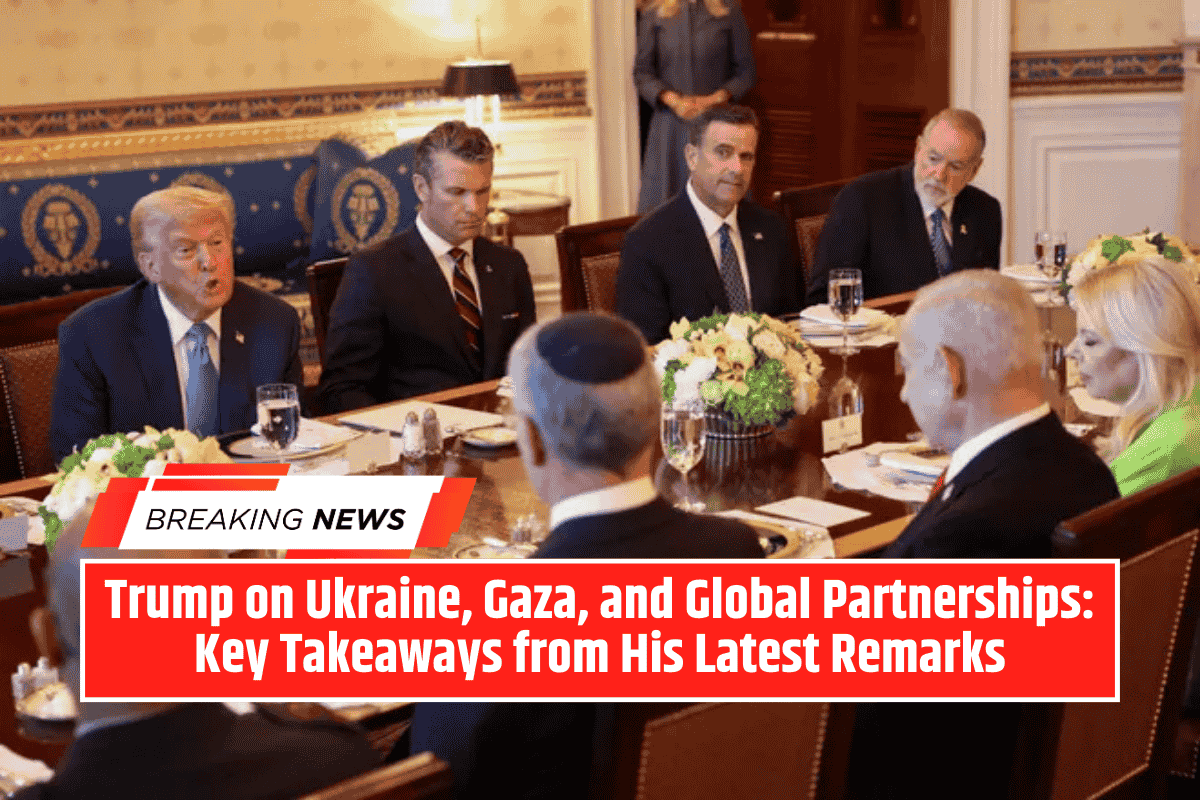
President Donald Trump announced that European leaders will visit the White House on September 8 or 9 to continue discussions on ending the war in Ukraine. While he did not name which leaders are expected, Trump emphasized that the talks will focus on resolving the conflict and strengthening cooperation with allies.
Trump condemned a recent Russian air assault on Kyiv’s main government building and reiterated his desire for peace. “The Russia-Ukraine situation, we’re going to get it done,” he said.
Trump also repeated that he expects to speak with Russian President Vladimir Putin “soon,” following his mid-August meeting at the White House with Ukrainian President Volodymyr Zelenskyy and several European officials.
“I’m not happy about the whole war,” Trump said, underscoring his stance. “No one has been tougher on President Putin. I am not thrilled with Putin.”
Optimism for a Cease-Fire in Gaza
Turning to the Middle East, Trump expressed confidence that a cease-fire between Israel and Hamas in Gaza could be reached “very soon.” He said fewer than 20 hostages remain and emphasized the urgency of securing their release before more lives are lost.
“I think we’re going to have a deal in Gaza very soon,” Trump said. He explained that Israel had already accepted the terms of his proposal, though Hamas has yet to do so.
Trump recently issued what he described as a “last warning” to Hamas on social media, urging the group to accept his terms without publicly revealing the details. “We’re working on a solution that may be very good,” he told reporters. “You’ll be hearing about it pretty soon. We’re trying to get it ended, get the hostages back.”
South Korean Factory Raid: Foreign Investment and U.S. Jobs
The president also addressed concerns from South Korean officials following a September 4 raid by U.S. Immigration and Customs Enforcement at a Hyundai factory under construction in Georgia. The raid led to the arrest of 475 workers, with more than 300 South Koreans now returning home.
While South Korean authorities expressed regret about the incident, Trump downplayed its effect on U.S.-Korea relations. Instead, he used the moment to reaffirm his administration’s stance on foreign investment in the United States.
Trump explained that his trade policies, including global tariffs, are designed to encourage foreign companies to expand operations in the U.S. but emphasized that jobs must go to Americans. “What we ask in return is that you hire and train American workers,” Trump said, echoing a message he had previously posted online.
Japan’s Prime Minister Resigns After Election Losses
In a surprising development in Asia, Japanese Prime Minister Shigeru Ishiba resigned on September 7 following significant election defeats for his party. Rising living costs fueled voter dissatisfaction, resulting in the loss of majorities in both houses of parliament.
Ishiba had recently finalized a trade agreement with the U.S. to lower tariffs on Japanese goods, strengthening economic ties between the two countries. However, he said he could not remain in office after the electoral setbacks.
Trump admitted he was “a little bit surprised” by Ishiba’s decision, noting the leader’s role in advancing the trade deal. Ishiba’s resignation injects uncertainty into Japan’s political future and its economic relationship with the U.S.
A Broader Vision of Diplomacy and Policy
Trump’s latest remarks highlight his broader diplomatic and domestic priorities:
- Ending the war in Ukraine: By hosting European leaders and planning talks with Putin, Trump is pushing for a resolution to one of the world’s most pressing conflicts.
- Securing peace in Gaza: His “last warning” to Hamas underscores his determination to bring about a cease-fire and ensure the release of remaining hostages.
- Promoting U.S. jobs: Even while welcoming foreign investment, Trump insists companies hiring in America must prioritize American workers.
- Monitoring allies’ stability: Ishiba’s resignation shows how international political shifts could impact U.S. economic policy.
As Trump positions himself on the global stage, his approach combines optimism about resolving conflicts with firm expectations for U.S. economic interests.
His words suggest an effort to balance diplomacy with domestic priorities—while projecting confidence that solutions to some of the world’s toughest challenges may be “very soon” within reach.