Physicians have long relied on nuclear medicine scans such as SPECT (single-photon emission computed tomography) to monitor heart function, track blood flow, and detect hidden diseases. These techniques, however, depend on costly and complex detectors that limit accessibility.
Now, a team led by Northwestern University and Soochow University in China has developed the first perovskite-based gamma-ray detector capable of capturing individual photons with record precision.
Their innovation promises to make imaging technologies sharper, faster, more affordable, and safer for patients. The research, published in Nature Communications, could usher in a new era of nuclear medicine.
Why Perovskites?
Perovskites are a family of crystals best known for transforming solar energy research. Mercouri Kanatzidis, senior author of the study and a Northwestern chemistry professor, has spent over a decade exploring perovskites’ potential beyond solar applications.
In 2013, his group demonstrated that perovskite single crystals were highly effective for detecting X-rays and gamma rays, sparking global interest in their use for radiation detection.
“Now, we’re showing that perovskite-based detectors can deliver the resolution and sensitivity needed for demanding applications like nuclear medicine imaging,” Kanatzidis said.
Limitations of Current Detectors
Today’s SPECT imaging relies primarily on two types of detectors:
- Cadmium zinc telluride (CZT): Known for high precision but prohibitively expensive, often costing hundreds of thousands to millions of dollars per camera. CZT crystals are brittle, making them difficult to manufacture.
- Sodium iodide (NaI): Less costly but bulky and prone to blur, producing lower-quality images akin to looking through a foggy window.
Perovskite detectors offer a way around these drawbacks. They are easier to grow, cheaper to produce, and capable of delivering clarity that rivals or surpasses existing systems.
Building the First Perovskite Gamma-Ray Detector
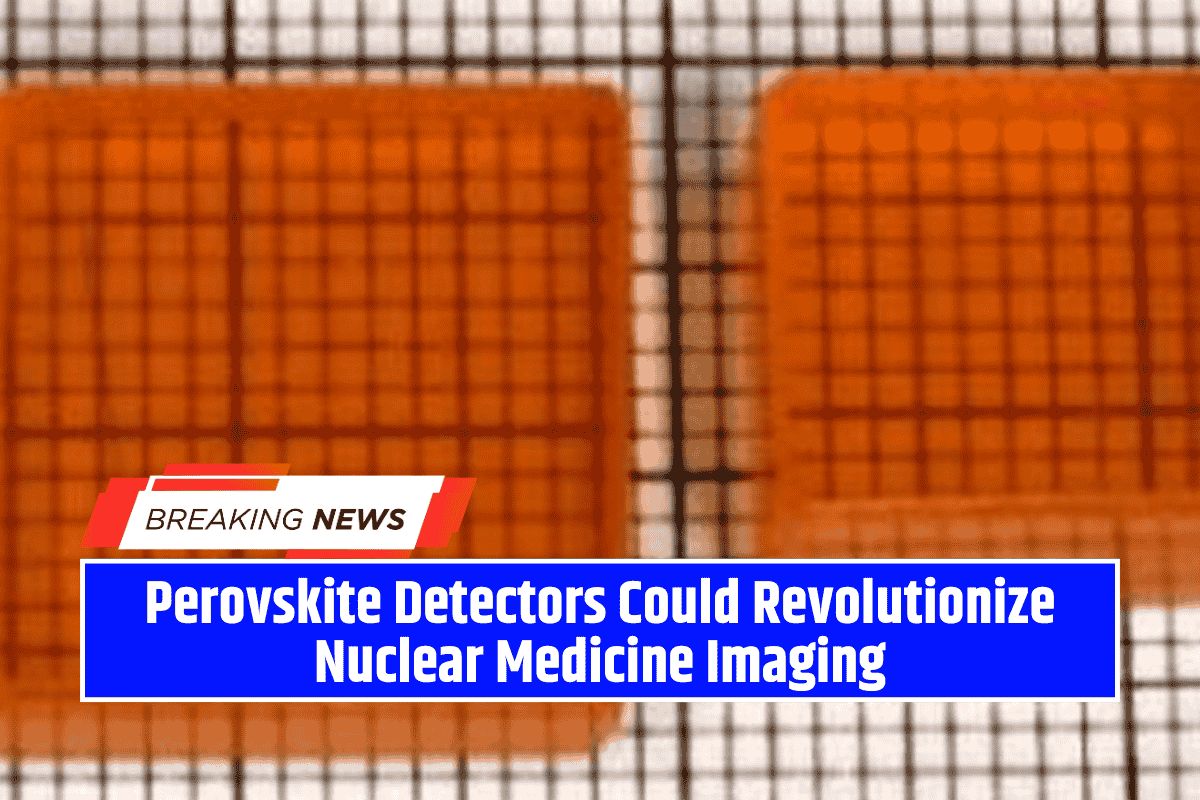
The international team combined expertise in crystal growth, surface engineering, and device design to create a pixelated perovskite sensor. Much like the pixels in a smartphone camera, these arrays capture detailed information with exceptional clarity.
Yihui He, co-corresponding author and professor at Soochow University, led the detector’s design, optimizing the multi-channel electronics and conducting imaging experiments. “By combining high-quality perovskite crystals with a carefully optimized pixelated detector and multi-channel readout system, we achieved record-breaking energy resolution and imaging capabilities,” He explained.
Record-Setting Performance
In laboratory experiments, the prototype detector demonstrated remarkable capabilities:
- Energy resolution: It differentiated gamma rays of different energies better than any detector reported to date.
- Sensitivity: It detected faint signals from technetium-99m, a commonly used medical radiotracer.
- Clarity: It produced sharp images that could distinguish tiny radioactive sources just millimeters apart.
- Stability: The detector collected nearly all signals without loss or distortion, ensuring reliable performance.
These advances mean patients could benefit from shorter scan times, lower radiation doses, and clearer results.
From the Lab to the Clinic
Northwestern spinout Actinia Inc. is already working to commercialize this breakthrough, collaborating with medical device partners to transition the technology into hospitals. Unlike CZT detectors, which remain financially out of reach for many clinics, perovskite-based systems could be scaled at lower costs.
Kanatzidis stressed the broader impact: “High-quality nuclear medicine shouldn’t be limited to hospitals that can afford the most expensive equipment. With perovskites, we can open the door to clearer, faster, safer scans for many more patients around the world.”
Potential for Global Health
Because perovskites combine affordability with high performance, they represent a path toward democratizing access to advanced nuclear imaging. More clinics worldwide could offer state-of-the-art scans without prohibitive investments, bringing life-saving diagnostics to underserved communities.
He described the achievement as a milestone: “Demonstrating that perovskites can deliver single-photon gamma-ray imaging shows these materials are ready to move beyond the laboratory and into technologies that directly benefit human health.”
Looking Ahead
The research team plans to refine detector performance, scale up production, and explore new applications. With ongoing support from U.S. and Chinese scientific agencies, including the Defense Threat Reduction Agency and the National Natural Science Foundation of China, further progress is expected.
As nuclear medicine continues to evolve, perovskite detectors may provide the foundation for the next generation of imaging tools—delivering sharper images, quicker scans, and safer procedures.